
Simultaneous Execution vs Leader-Follower: How Trade Copiers Actually Work
Simultaneous execution and leader-follower copying answer different questions. What each approach can and cannot copy on Tradovate, and how to test any copier in Demo first.

Trade copier marketing has picked a new fight. On one side is "simultaneous execution": one alert fires and every account gets the order at once. On the other is "leader-follower": one account trades and the rest copy it. Depending on whose homepage you read, one of them is modern and the other is broken.
Both descriptions skip the question that decides whether a copier fits you: what does it listen to? A copier can only copy what it can see. Pick the wrong listener and the copier isn't slow, it's blind, and blind is the failure that costs evaluations.
This guide walks through the three things a copier can listen to, what each one catches and misses on Tradovate, and a Demo test that tells you which one you're actually buying.
A trade copier is a listener and a replicator
Strip away the branding and every copier has two parts. The listener decides which events count as a trade. The replicator turns each of those events into orders on your other accounts, applying sizing, symbol and risk rules on the way.
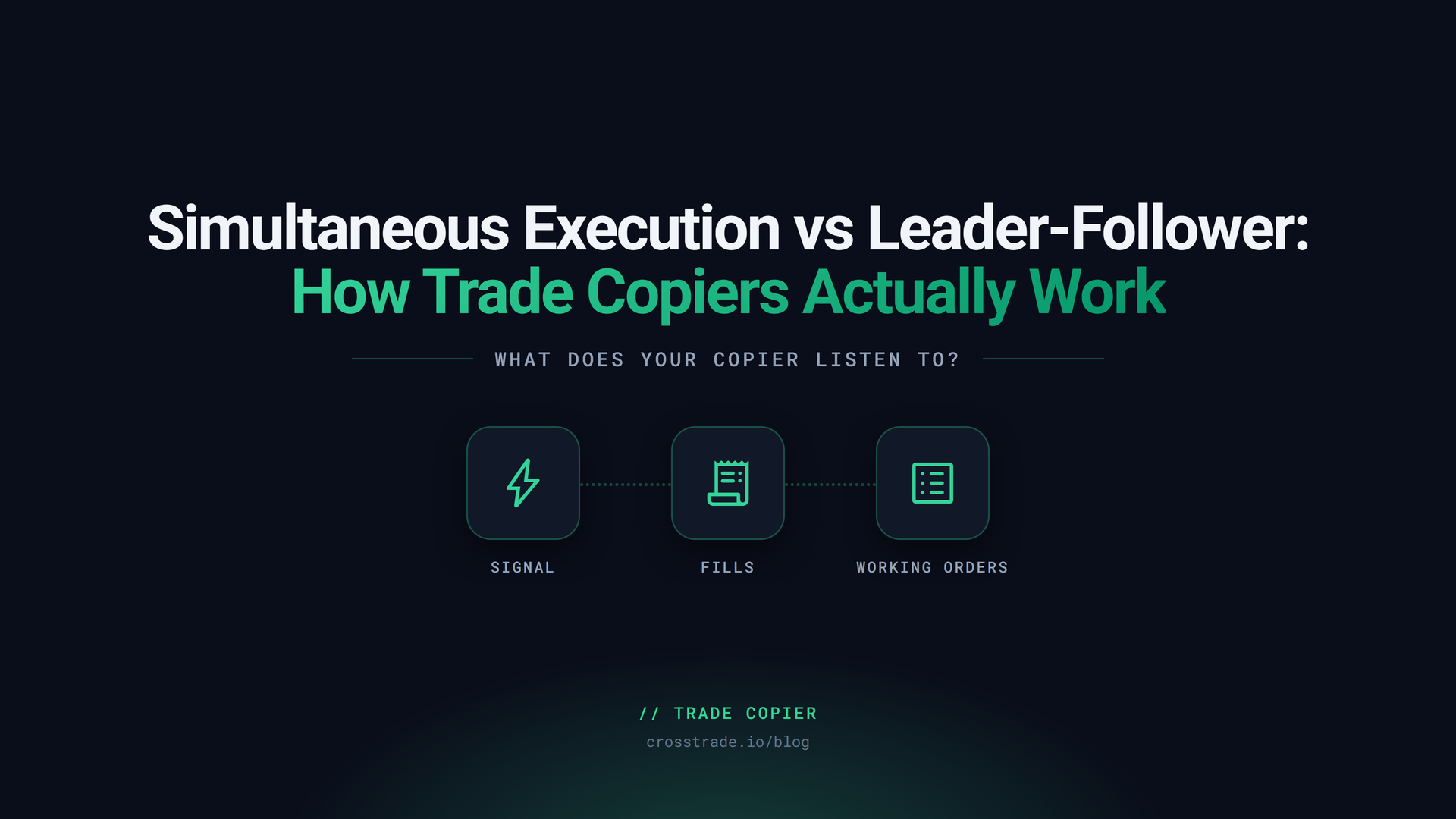
Replicators are mostly the same shape. Listeners are where copiers genuinely differ, and there are only three places to listen. You can listen to the signal, before it reaches the broker. You can listen to the fills, after the broker executes. Or you can listen to the working orders at the broker itself: every placement, change and cancel on the leader account, whether it has filled or not.
"Simultaneous execution" is the first. Classic "leader-follower" is the second. The third rarely gets a marketing name, and it's the hardest one to build.
Simultaneous execution: copying the signal
A signal copier sits between your alert and your broker. The webhook arrives, the copier expands it into one order per account, and it sends them all in parallel. Nobody waits for anybody. Every account gets the same order type at nearly the same moment, so a limit entry is a limit entry everywhere, and a bracket rides along if the alert carries one.
That's a good design for automated strategies, and CrossTrade supports it two ways. On Tradovate, you can list the accounts right in the alert:
key=your-secret-key;
command=place;
account=DEMO12345678,DEMO12345679,DEMO12345680;
instrument=MES1!;
action=buy;
qty=1;
order_type=market;
tif=day;
destination=tradovate;
CrossTrade launches each account's order concurrently, runs each one through that account's own controls, and records each result separately in Alert History. That's multi-account placement, and it has no leader at all.
The second way is the Tradovate trade copier's Signal mode, which adds a leader. Your alert trades the leader account, and as soon as Tradovate accepts that order, every follower gets its own version in parallel, with its own sizing ratio, max position cap, instrument filter and, for market orders, symbol swap (ES on the leader, MES on a follower). If Tradovate rejects the leader order at placement, no follower order is sent. Brackets ride along to every follower as the same server-side OSO.
Here's the limit of any signal copier, ours included: it only knows about trades that pass through it. Click buy in Tradovate's web app, trade from TradingView's Tradovate panel or your phone, drag a stop, cancel a working limit, and a signal copier never hears about it. The leader and followers quietly stop matching. A pure alert router has no leader to compare against, so nothing flags it. CrossTrade's Signal mode at least compares leader and follower after each copy and writes a drift warning to the copy log, but it still won't copy the trade it never saw.
If every trade you take starts as an alert, none of that matters. If some of them don't, it's the whole ballgame.
Leader-follower: copying the fills
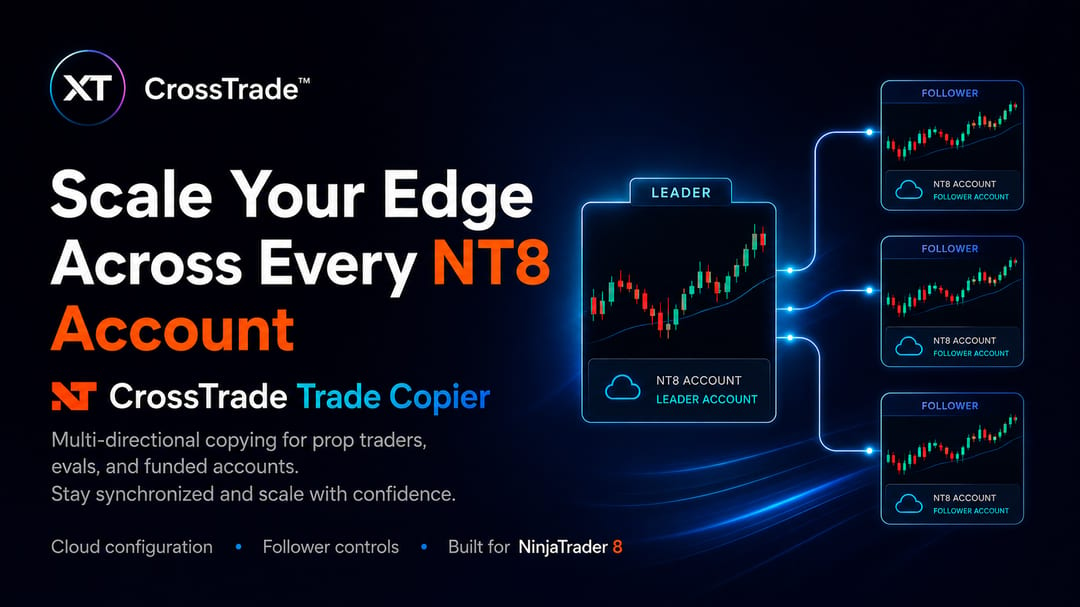
A fill copier watches the leader account at the broker and reacts to executions. When the leader fills, the followers get a market order. It doesn't care what placed the leader's trade: a webhook, a manual click, a tap on your phone, an order from TradingView's panel, an ATM target leg. If it filled, it copies.
That's also where "leader-follower" got its bad reputation. The follower order can't leave until the leader's fill exists, so followers enter a beat behind, at market, at whatever price is left. And because fills are all it sees, resting orders aren't mirrored. A follower holds no take-profit or stop of its own and exits only when the leader's exit fills and gets copied across.
CrossTrade's version is Execution mode on the Tradovate copier. It suppresses duplicate broker events, recognizes its own copies so a copy never gets copied again, and carries fractional sizing forward so a 0.5x follower still ends flat after scaled entries and exits. With Auto-Sync on, it also corrects follower drift after each copy and on reconnect. It's the right tool when you trade the leader by hand and followers entering at market is acceptable. It's the wrong tool if each follower needs its own protective bracket at the broker, and the Tradovate copier docs say so in a warning box.
Order mirroring: copying the working orders
The third listener also watches the leader at the broker, but it watches orders instead of fills. When the leader places a limit, each follower places the same limit. Move the leader's stop and every follower's stop moves. Cancel on the leader and the followers cancel. Brackets and OCO pairs go on as linked orders, so a fill on one leg cancels its sibling at the broker.
That combines the useful half of both approaches. Like a fill copier, it sees trades whatever placed them, manual and TradingView-panel orders included. Like a signal copier, followers hold real resting orders with real protection instead of chasing fills at market. It's also the hardest to build, because the copier has to track a family of linked orders on every follower and keep them in step through changes, partial fills and reconnects.
On Tradovate this is Order mode, currently in beta. Two behaviors are worth knowing before you rely on it. Turning a copier on doesn't adopt orders already resting on the leader, so there's no burst of copies at setup. And if the leader partially fills and then cancels the rest, the follower's remainder is canceled too, and with Auto-Sync enabled the size difference is corrected. On NinjaTrader 8, Order mode mirrors the whole NT8 order book, and its Fills Only option narrows it to market-order fills.
So which one is better?
Neither, in general. The honest answer is the one the marketing avoids: it depends on where your trades start.
If every trade starts as a TradingView alert or your own code, copy the signal. It's the most direct path, followers keep the same order types, and nothing waits on a fill. Use multi-account webhooks when there's no natural leader, or Signal mode when you want a leader account plus per-follower sizing, symbol swaps and position caps.
If you trade by hand, even occasionally, a signal copier will miss those trades, so you need one that listens at the broker. Choose Execution mode when market-order copies are fine, or Order mode when followers need the same resting stops and targets as the leader.
If you do both, you want a copier that lets you pick the listener per copier instead of one that picked it for you. That's why the CrossTrade Tradovate trade copier runs all three modes, and why a leader account in NinjaTrader 8 gets the same kind of choice from the NinjaTrader trade copier, in Order and Execution modes.
Speed is the least interesting number on the page
Copier homepages love millisecond figures, and some quote two different ones on the same page. Latency matters, but it's rarely what fails an evaluation. A copy that lands 40 milliseconds late costs you a tick or nothing. A trade the copier never saw, a copy sent twice, or a follower left unprotected after its leader's bracket filled can cost you the account.
Measure timing yourself, on your own accounts, in Demo. CrossTrade's Alert History and copy log show when the leader order and each follower copy went out, so you can see the gap directly instead of trusting anyone's headline number, ours included.
Test the listener before you trust the copier
Whatever you use, run this in Demo with one leader and two followers before a funded account sees a single copy. Send an alert with a bracket and confirm each follower got the entry and both protective legs. Place a trade by hand in Tradovate and see whether it copies. Drag the leader's stop, cancel a resting limit, then check the followers. Send an order the leader account should reject and confirm what the followers did. Then compare every account against the leader.
Ten minutes of that tells you which listener you actually bought. The pre-live verification checklist turns it into a written procedure, and How to Test a Trade Copier on Funded Accounts Before Going Live covers the prop-firm side.

New to CrossTrade? Start your free 7-day trial and put a leader and two followers through the test above in Demo. Want a second opinion on which mode fits your setup? Our team and a few thousand futures traders are in Discord.