Vibe Coding Trading Strategies Needs a Verification Loop
Vibe coding is fine for weekend apps. Trading needs the next step: compile against the real platform, backtest in the real engine, and gate deployment behind explicit user confirmation.

Vibe coding makes prototyping software faster. For trading strategies, the prototype is not the product. A few lines of NinjaScript that compile to a green light in the chat are not a strategy. They are a draft.
This post is the trader version of "why generated code is not enough" and what CrossTrade MCP adds to close the gap.
Why vibe coding is popular with traders
Most futures traders have ideas they would like to test. Most of them never test them because writing NinjaScript from scratch is friction. The AI coding wave changed the bar; describe the strategy in plain English, get C# back, paste it into NT8.
The first draft almost never works. The model invents indicators, uses the wrong overload, picks a removed method. The trader pastes the compile error back into the chat. The model apologizes and produces a new mistake. After 45 minutes of this, the trader gives up.
This is the part that makes vibe coding feel useless for trading: there is no feedback loop that converges.

Why generated code is not enough
Even if the code compiles, several gaps remain:
- The code does not match the spec. The model invents session logic or picks a different entry condition. Looks plausible. Trades differently.
- The backtest is in the wrong engine. Generic Python backtesters or notebook simulations produce numbers that have nothing to do with NT8 Strategy Analyzer.
- Slippage and commission are zero. The metrics block looks great. Live conditions do not.
- Trade count is tiny. Eight trades over a month is not edge.
- Sweeps overfit. A wide parameter sweep finds noise. The winner looks confident in-sample and bleeds out-of-sample.
- Risk rules are not in the code. Daily loss, max contracts, news windows — none of these are enforced by the strategy itself.
Generated code is the starting point of a verification process. The process is the part most "vibe coding for trading" posts skip.
The CrossTrade verification loop
CrossTrade MCP closes the gap by giving the AI agent four things it cannot have on its own:
- Real NT8 symbol surface.
GetNinjaScriptHelp,SearchNinjaScriptSymbols,LookupNinjaScriptSymbol. The agent looks at your install, not at training data. - In-memory compile.
CompileNinjaScript(in_memory: true)runs against the live NT8 AppDomain without touching disk. The diagnostic is structured. The agent reads it in the same context as the source. - Bit-identical Strategy Analyzer.
RunStrategyBacktestdrives NT8's actual engine. Single backtests match the desktop UI for the documented reference. The agent's deploy decision and your read both rest on the same numbers. - Scoped permissions and confirmation gates.
mcp:tradefor compile and backtest; explicit confirmation in the prompt for every irreversible write.
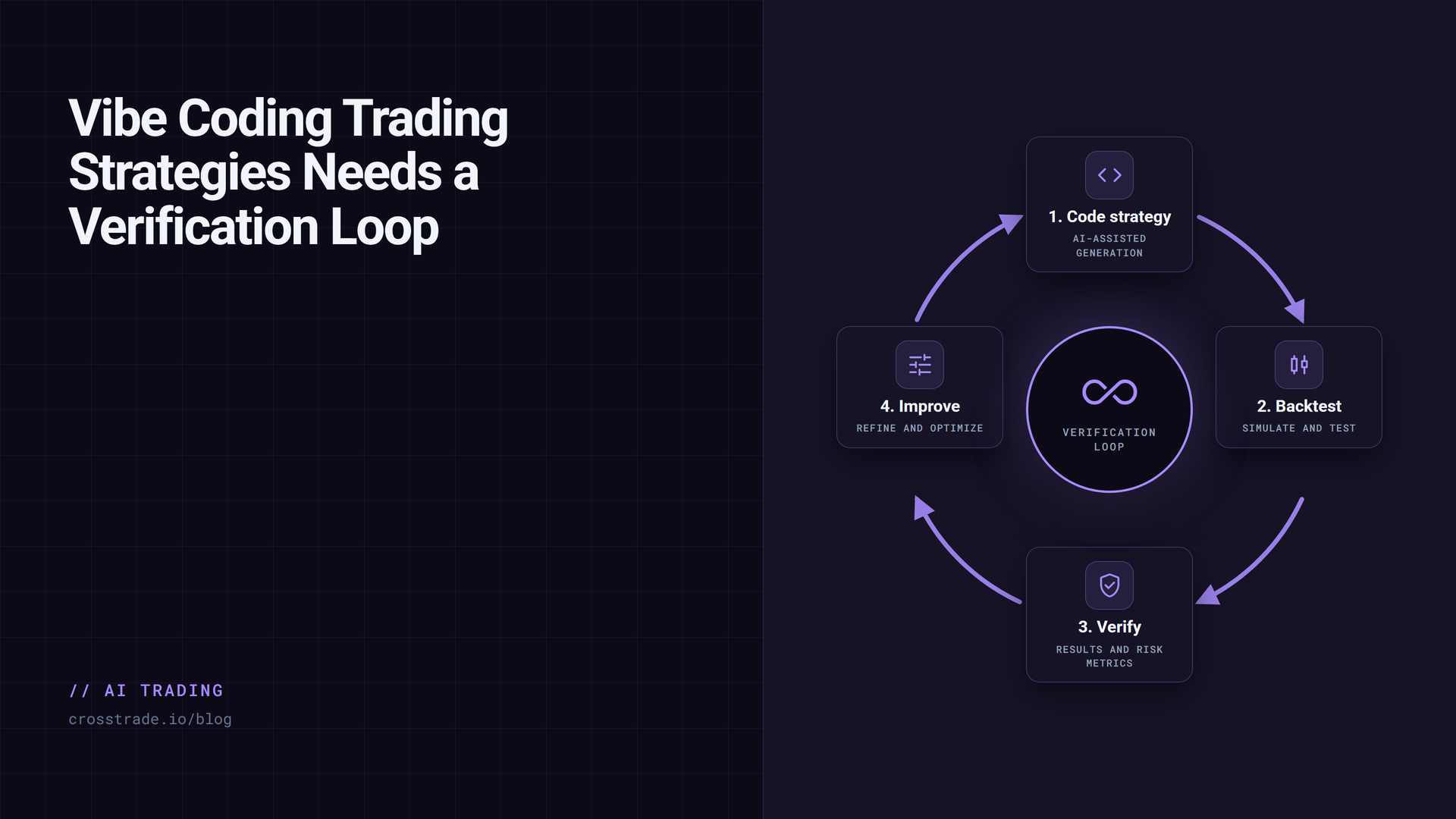
The agent's loop becomes: ground the model in real symbols, draft the source, compile in memory, repair on failure, write the file with confirmation, backtest with realistic costs, apply quantitative gates, present an honest risk review. Each step is a typed tool call. The trader is in the loop at every door that matters.
Example: prompt to compile to backtest
The spec, written in trader language:
Long MES on the break of the first 15-minute range. ATR-based trailing stop, multiplier 2.0. Maximum two trades per session. 09:30 to 11:00 ET. Sim101 only.
The first AI prompt:
Before drafting, call GetNinjaScriptHelp on TimeFilter, ATR, EnterLong, and SetTrailStop. Restate the chosen overloads. Then draft the source. Compile in memory. If it fails, look up the unresolved identifiers and rewrite. Recompile until green. After confirmation, write the file. Backtest April 1 to April 30, 2026, 5-minute bars, commission $1.27 per round-trip, slippage 1 tick. Apply gates: profit factor > 1.25, max drawdown < $500, trade count > 40. Report pass or fail. Then list five reasons not to deploy.
The agent issues dozens of tool calls. The trader watches the conversation. At the end, the strategy either passes the gates with a meaningful trade count or it does not. Either way, the verification has happened. The trader is not pasting compile errors back to the chat at midnight.
What about funded futures
Vibe coding builds a strategy. The strategy does not enforce firm rules. Apex prohibits automation. Topstep permits automated strategies in the Combine with caveats. TakeProfitTrader has news-window prohibitions. The agent can encode these in the system prompt and refuse trades that would violate them; the firm's risk system still has final say.
The right move is to keep vibe coded strategies on Sim101 first. Run them for several sessions. Read the trade list. Decide separately whether a funded account is the right place for them, and verify the firm's rules before that decision.
The rule
Vibe code the idea. Verify the result.
For the full tutorial with prompts and screenshots, see How to Vibe Code a NinjaScript Strategy in NinjaTrader 8. For the backtest verification step specifically, see How to Backtest AI-Generated NinjaScript in NinjaTrader 8.
For the technical reference, see NinjaScript AI Workflow and the NinjaScript Backtest Benchmark.
Vibe coding without verification is not a workflow. It is the rough draft of one.